I have eventually finished the paper wig which I started well before christmas. I just need tophotograph it properly so that I can use it as part of my portfolio.
Showing posts with label A Rake's Progress. Show all posts
Friday, 18 January 2013
Friday, 11 January 2013
Finished newspaper cover
This is my final design for the front cover of my newspaper. I think that overall it look good, might be better if I had put a few adverts on it just to make it more realistic. I think the colours I have used work okay in each image and as a whole. The main thing that I struggled with was the type, fitting it into the boxes. I managed to get it all to fit by tweaking small parts. I took some of the colour out of the background as well, I thought it was overpowering, it looks much better as it is now.
Friday, 14 December 2012
Newspaper Cover Evaluation; Session 2
For this session we now have to use the three colours, from the paintings that we did yesterday, to transfer the digital imagery into tritones. It defiantly needs a lot of work doing to it. I don't think that the background colour works very well, I think that It would look better if the colour wasn't as strong as it detracts from the images in the articles. I think that there need to be more contrast with some of the pictures also as you loose some of the detail in them. I need to make room within each of the article spaces for the headlines as well, which I haven't done at the moment.
I think I am going in the right direction with is all though. I have made the whole thing slightly wider as well so that everything would fit in it better, I think that this is the final template that I will slick with.
Box and Mannequin; Session 2
In this session I finished covering the mannequin and the box ready for my to cover them in scrim and plaster. I covered the box in black bin liners because it was easier than using cling film. The picture below shows the whole thing before I started putting plaster on it.
This shows how far I got with the plaster and the scrim in that one session. I got the main shape created on these two side but on the other sides I need to add more scrim and plaster to make a better shape. I like unfinished effect that using this material has created at the bottom, as I had the character of the harlot in mind so wanted to created something that look worn. I think that when I finish the other side it will look really good.I could also use this technique with different materials such as newspaper with pva and water and fabric with pva and water. Using these would stiffen the material so could help me create more of a structured piece.
Thursday, 13 December 2012
Newspaper Cover Evaluation
This is my newspaper front cover after the first week of doing it. Obviously its only the very basic start to this project for me to build on next week.
Overall I think that the layout works well, its just a case of dropping all my pictures and text into the boxes to see where they would work best. I think the background colour needs changing slightly, having a little more of a brown tone to it. I think I should lay the back ground image over the whole of the piece as well so that the whole cover looks a bit more realistic. I also have the life drawing piece that we did today to slot into it somewhere so might have to rejig or take something out of the layout. I will also have to change images to tritones as that is what we have now been told to do to restrict us a bit more.
Thursday, 6 December 2012
Box and Mannequin
As a final sort of experimentation thing at the end of this term we have to use the techniques that we have learnt and put into practice, from the last few weeks, to create work that is more structured towards our subject area. I had a quick flick through my costume ideas to get an idea of where to go with my work. We had to take a element of a Rake's Progress also, I thought that a good thing to do would be to look at the structure of the women dresses focusing mainly on the skirt of the dress.
I took a few quick photos of where I am up to with it now. I came across a few problems with the length of the mannequin so I had to drop it into the box and support it with a chair and some bricks so that it was the right height for the mannequin to sit on. The bottom photo shows the model ready for casting, I am going to use scrim and plaster to create the casts, I will just have to see how that turns out next week.
Friday, 30 November 2012
A Rake's Progress theatre poster
Within our graphics lessons we have now got to create a poster to advertise a performance of A Rake's Progress. I did some initial research into different poster designs, I came across the image below whilst having a general look through them all.
I like the fact that this is just a really simple poster, it has the relevant information on it and is not to crowded with imagery. For my first attempt at creating a poster I used this simple layout to help me.
This is where I am up to at the moment with creating a design. The images are not entirely relevant, they are just place holders until I create images that would work better. Overall though I like the layout of this poster I think it just needs slightly more information on it, such as where to buy tickets from or the main actors/ actresses in it.
Saturday, 24 November 2012
Design Improvement
I am working at my designing skill because I think the way I was designing at the end of last year wasn't brilliant. This is where i'm at up to yet with it. They are a definite improvement on what I was doing at the beginning of the year.
I just need to look more into a character now to base my designs on. I'm defiantly going in the right direction with it all though.
Wednesday, 7 November 2012
Metamorphosis: Titian 2012- Artists
These videos show the three artists that created the ideas behind the three ballets. They give you an insight into theit thought processes and the different ways that the artists went to create an end product for this project.
This is a slightly terrible news report but I couldnt find any other videos of Mark Wallinger's work in this exhibition.
I have also looked through the videos on the National Gallery webistes but for some reason they will not embed into my blog.
18th Century Clothing
http://miss-kseniya.blogspot.co.uk/2010/09/18-century-fashion.html
Women's clothing styles retained an emphasis toward a conical shape of the torso while the shape of the skirts changed throughout the period. The hoop-skirts of the 1740s were left behind, but wide panniers (holding the skirts out at the side) came into style several times, and the aesthetic of a narrow inverted cone, achieved with boned stays, above full skirts remained.
The usual fashion of the years 1750-1780 was a low-necked gown (usually called in French a robe), worn over a petticoat. Most gowns had skirts that opened in front to show the petticoat worn beneath. If the bodice of the gown was open in front, the opening was filled in with a decorative stomacher, pinned to the gown over the laces or to the corset beneath.
Tight elbow-length sleeves were trimmed with frills or ruffles, and separate under-ruffles called engageantes of lace or fine linen were tacked to the smock or chemise sleeves. The neckline was trimmed with a fabric or lace ruffle, or a neckerchief called a fichu could be tucked into the low neckline.
The robe à la française or sack-back gown featured back pleats hanging loosely from the neckline. A fitted bodice held the front of the gown closely to the figure.
The robe à l'anglaise featured back pleats sewn in place to fit closely to the body, and then released into the skirt which would be draped in various ways
Shoes had high, curved heels (the origin of modern "louis heels") and were made of fabric or leather. It was particularly common for shoe buckles to be worn as an "ornament" to the foot in high society, principally at balls and parties, and made an important feature of the "dandy" image.
Useful parts of the post that features on her blog.
Women's clothing styles retained an emphasis toward a conical shape of the torso while the shape of the skirts changed throughout the period. The hoop-skirts of the 1740s were left behind, but wide panniers (holding the skirts out at the side) came into style several times, and the aesthetic of a narrow inverted cone, achieved with boned stays, above full skirts remained.
The usual fashion of the years 1750-1780 was a low-necked gown (usually called in French a robe), worn over a petticoat. Most gowns had skirts that opened in front to show the petticoat worn beneath. If the bodice of the gown was open in front, the opening was filled in with a decorative stomacher, pinned to the gown over the laces or to the corset beneath.
Tight elbow-length sleeves were trimmed with frills or ruffles, and separate under-ruffles called engageantes of lace or fine linen were tacked to the smock or chemise sleeves. The neckline was trimmed with a fabric or lace ruffle, or a neckerchief called a fichu could be tucked into the low neckline.
The robe à la française or sack-back gown featured back pleats hanging loosely from the neckline. A fitted bodice held the front of the gown closely to the figure.
The robe à l'anglaise featured back pleats sewn in place to fit closely to the body, and then released into the skirt which would be draped in various ways
Shoes had high, curved heels (the origin of modern "louis heels") and were made of fabric or leather. It was particularly common for shoe buckles to be worn as an "ornament" to the foot in high society, principally at balls and parties, and made an important feature of the "dandy" image.
Useful parts of the post that features on her blog.
Monday, 5 November 2012
Ballet- A Rakes Progress
For the Rakes progress rather than just copying clothing from the paintings I want to change them to fit a different style of performance. I wanted to do this so that I had more restrictions that I would have to work towards to give me more of a challenge when designing, making it fit the Rakes Progress but in a certain style of performance.
http://www.vam.ac.uk/content/articles/m/movement-in-stage-costume-design/
On this page it explains about the restricitons of dance costume. taking into consideration things like the demands of the choreography and which materials would be suited to allow that movement.
http://www.vam.ac.uk/content/articles/d/designing-stage-costumes/
This page shows different ways of designing for stage costume.
Just one of the designs off that page. Including fabric swatches and a detailed design.
http://www.vam.ac.uk/content/articles/m/movement-in-stage-costume-design/
On this page it explains about the restricitons of dance costume. taking into consideration things like the demands of the choreography and which materials would be suited to allow that movement.
http://www.vam.ac.uk/content/articles/d/designing-stage-costumes/
This page shows different ways of designing for stage costume.
| Costume design for 'Sherrin' in 'The Mines of Sulphur', Alix Stone, 1965 |
Saturday, 3 November 2012
18th Century Jumper
We got given an old jumper for the base of this project. We had to take it and chop and change bits for a deign that have created for a character from either A Rakes Progress or A Harlots Progress. I chose the same character as the one that I used for the wig which was Moll Hackabout, the main character in A Halots Progress.
These are just the quik initial sketches that I did for this project. The design that I came to are the ones furthest to the right. Obviously I ned to do some more research into this era of dress to have a look at finer detailing. Bits and bobs that will give it a nice finish.
To begin with i just cut straight down the front of the jumper in order for me to be able to fold it over to create the shape that I wanted. I havnt sewn any of it down as if I change the shape of it in my designs, through doing more research, I can then easily change the shape of it.
This shows the next thing that I did to change the jumper into the design that I had created. I created three slits in it, one done the back and one down each of the seams. The length of the cut ends at the point where the waist is the thinest. I cut it up to this point because during the 18th century a laides waist would be made too look thinner by doing this and then adding pleats like the one below to make the bottom look fuller.
Using a thicker material for the pleats works well as it creates structure to a material that otherwise would just drap, which would not be fitting to the early 18th century.
I will have to look at how to breakdown the costume, so that it shows Moll Hackabout's story up to that point,to do this i need to pick which part of the story I am designing for.
Thursday, 1 November 2012
Large tavern piece- Complete for now
Monday, 29 October 2012
Metamorphosis: Titian 2012
‘Metamorphosis: Titian 2012’ – featuring new work by contemporary artists Chris Ofili, Conrad Shawcross and Mark Wallinger in a unique collaboration with The Royal Ballet.
This multi-arts project, part of the Cultural Olympiad's London 2012 Festival, draws on the powerful stories of change found in Titian’s masterpieces, revealing how these spectacular paintings continue to inspire living artists.
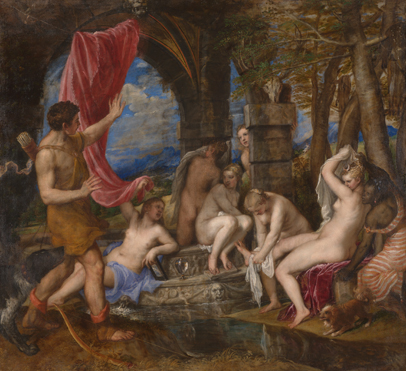
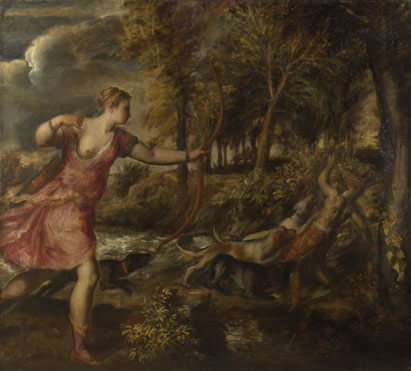
A multi-faceted experience celebrating British creativity across the arts, ‘Metamorphosis: Titian 2012’ brings together a group of specially commissioned works responding to three of Titian’s paintings – Diana and Actaeon, The Death of Actaeon and the recently acquired Diana and Callisto – which depict stories from Ovid’s epic poem ‘Metamorphoses’. The three paintings, displayed at the heart of the exhibition, are seen together for the first time since the 18th century.
http://www.nationalgallery.org.uk/whats-on/exhibitions/metamorphosis-titian-2012
Seven royal ballet choreographers from the Royal Ballet teamed up with composers and the contemporary artists, Chris Ofili, Conrad Shawcross and Mark Wallinger. Together they have produced responses to the three Titan paintings which were then performed at the Royal opera house in July 2012.
A multi-faceted experience celebrating British creativity across the arts, ‘Metamorphosis: Titian 2012’ brings together a group of specially commissioned works responding to three of Titian’s paintings – Diana and Actaeon, The Death of Actaeon and the recently acquired Diana and Callisto – which depict stories from Ovid’s epic poem ‘Metamorphoses’. The three paintings, displayed at the heart of the exhibition, are seen together for the first time since the 18th century.
http://www.nationalgallery.org.uk/whats-on/exhibitions/metamorphosis-titian-2012
Seven royal ballet choreographers from the Royal Ballet teamed up with composers and the contemporary artists, Chris Ofili, Conrad Shawcross and Mark Wallinger. Together they have produced responses to the three Titan paintings which were then performed at the Royal opera house in July 2012.
Tuesday, 23 October 2012
A Rake's Progress- large scale piece 2
This is are second attempt at the large scale piece for the tavern scene in a Rake's Progress. These first two photos show the initial background that we did for our piece. Even at this point without any detail on it I think that it already looks better than the piece that we had done previously.
We didn't add much colour to the background so that the details and key features, when put on top stand out from the background.
We decided to put the figures into the piece we would create layers of fabric to place on top of the background, rather than painting them on because the background might have smudged into them.
This shows the figures placed on the background. To create the figure shapes we drew around each other. We chose to use white fabric for the figures so that they would stand out from the dark background. I think that the figures work well but they need something, like the table in the painting, to pull the whole composition together as some of the figures look like they are floating.
Close up of Tom Rakewell's representation in the piece. We chose to dress this character because he is the main focal point of the artworks therefore we wanted him to stand out more from the other figures.
Thursday, 18 October 2012
A Rake's Progress- large scale tavern 1
![]() |
| these are the the photos of the two halves of the first piece |
This was a first attempt at a large scale piece for A Rake's Progress. As a group we chose to base are piece on one of the scenes, we chose the tavern because we thought it would make the most interesting piece.
We managed to get all the key elements into the piece but I don't think that this piece works as a whole, there are too many different things happening with nothing to pull them all together. I think with this piece there needed to be more thought gone into it in order for it all to work. I also think that the background would have needed to be darker to show the darkness within the original tavern panting.
Monday, 8 October 2012
18th Century Wigs
I have looked at 18th century portraits to have a look at the styles of hair and wig. Doing this will then give me more of an idea as to which direction I want to take the wig that I am making.
| Caroline of Ansbach- Spouse of King George II |
| Lady Georgiana Cavendish, Duchess of Devonshire |
I wanted to make a wig based on the Harlot of a Harlots Progress. I looked at portraits of the aristocracy of the 18th century, from these I could get a feel of what kind of look the Harlot would want but defiantly wouldn't have. The harlots would be bigger and more brash, the bigger the better. She would have tried to achieve a classier look but look like one of these hairstyles that had been lived in for a week and all started to fall out and look messy.
Thursday, 27 September 2012
Chatsworth Chairs
I tried taking pictures of different textile things in the house to give me and idea of some patterns and fabrics from around the era of a Rakes Progress. These are the only two pictures containing the textile things that have come out so you car see the detail on them. I can use these to help in my textile sessions and also to help with fabric patterns in costume sessions.
Wednesday, 26 September 2012
Chatsworth Research
I want to use this visit to help me with the Rake's Progress. As the history of chatsworth goes through the 18th century i want to look at the painting and portraits from the relevant era to see what clothing they would have been wearing. I can then use this information and the pictures that i have taken to use it as a basis for the first designs that i will do in my costume sessions.
portraits to look at:
-William Cavendish, 3rd Duke of Devonshire
-William Cavendish, 4th Duke of Devonshire
-Katherine Hoskins, Duchess of Devonshire
-Portrait of Lady Charlotte Boyle, Marchioness of Hartington
-Richard Boyle, 3rd Earl of Burlington and 4th Earl of Cork
All of these people were alive through the year of 1733, which is the same year as A Rake's Progress was painted, so i particularly want to look at the clothing in these five.
portraits to look at:
-William Cavendish, 3rd Duke of Devonshire
-William Cavendish, 4th Duke of Devonshire
-Katherine Hoskins, Duchess of Devonshire
-Portrait of Lady Charlotte Boyle, Marchioness of Hartington
-Richard Boyle, 3rd Earl of Burlington and 4th Earl of Cork
All of these people were alive through the year of 1733, which is the same year as A Rake's Progress was painted, so i particularly want to look at the clothing in these five.
Monday, 24 September 2012
Layers of women's 18th century clothing
This video shows the order and the layers of womens clothing during the 18th century. Using this I can breakdown the clothing of all the women featured in a Rakes Progress. From looking at this I can take into account all aspects when creating designs for the different characters. Looking at the video I can pick the aspects out that would be associated with the different classes of women to make the costumes more accurate.
Subscribe to:
Posts (Atom)


.jpg)